
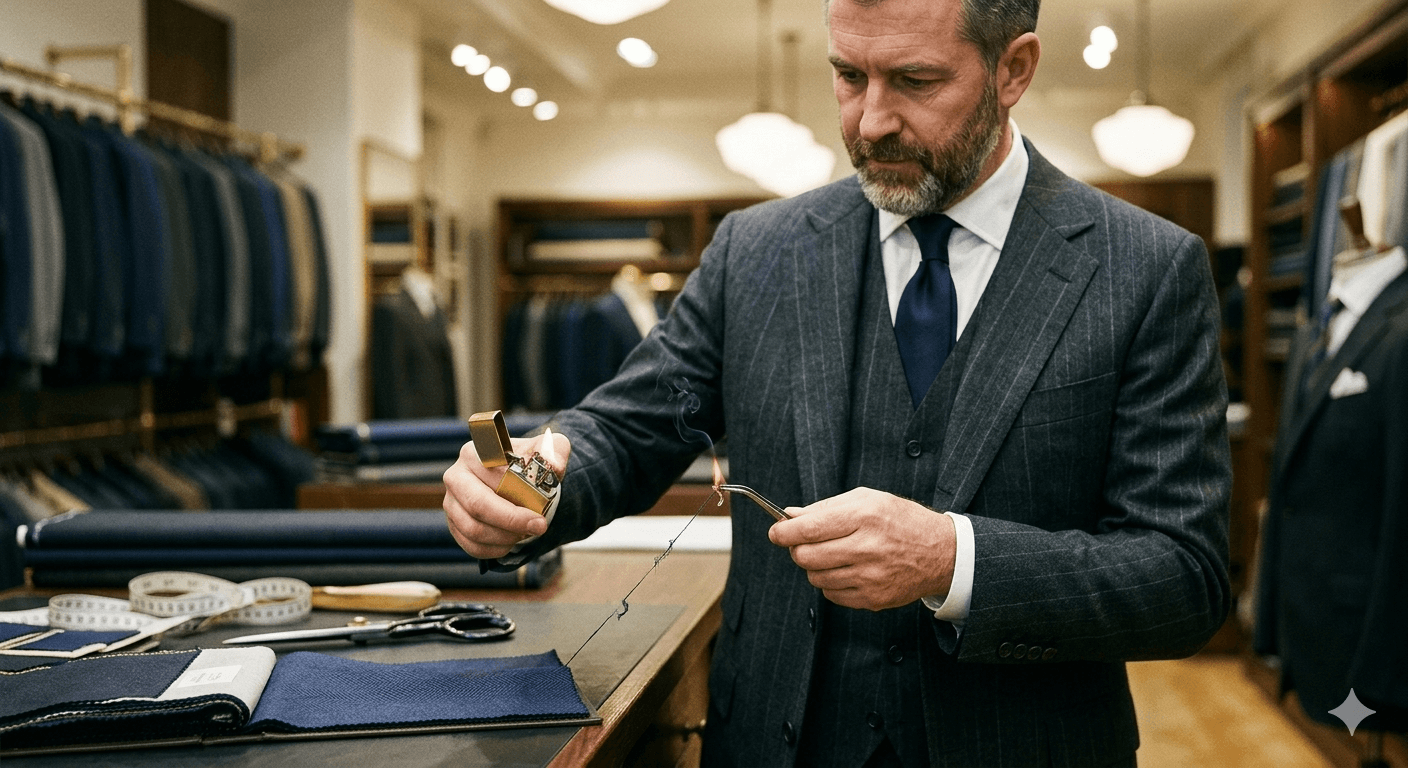
How to Use a Lighter to Catch Dishonest Tailors and Fake Luxury Fabrics
The textile burn test is a definitive method to authenticate luxury suit fabrics against synthetic counterfeits. Pure wool burns slowly, smells like burning hair, and leaves crushable ash—whereas synthetic polyester melts rapidly into a hard plastic bead.
The Problem with Fake Luxury Fabrics
Walk into any bespoke tailor Sukhumvit hub, and you will find walls lined with gorgeous fabric bunches. Prestigious mill names are stamped proudly on the selvage, and salespeople promise pure, breathable, ultra-luxury wool for your next bespoke suit.
Yet, in a competitive urban market, things are not always as they appear. Far too many clients pay premium prices for authentic Italian wool, only to discover they have been sold a stiff, sweaty synthetic blend.
To protect your investment and ensure you are working with a trusted custom tailor in Bangkok, you must know how to separate true master artisans from fraudulent operators.
The good news? You do not need a textile laboratory. You only need a pocket lighter and a single thread of fabric.
This is your ultimate guide to the textile burn test—your essential defense mechanism as a discerning connoisseur of “Quiet Luxury.”
Read More: Learn more about our complete Bespoke Suit Process & Fitting Guide.
Why Cheap Synthetics Pose as Luxury Wool
Before striking a flame, it helps to understand the deception.
True luxury tailoring relies entirely on natural fibers—primarily pure merino wool, cashmere, and silk. These organic fibers breathe effortlessly, drape elegantly against your silhouette, and form the foundation of a true full canvas construction suit that molds uniquely to your body over time.
Synthetic fibers like polyester and rayon, however, are essentially plastic. While a minor percentage of elastane or stretch synthetic is occasionally blended for specialized performance wear, passing off a heavy polyester blend as pure Super 130s wool is an unacceptable industry deception.
Synthetic suits trap tropical heat, develop an unflattering artificial shine under an iron, and remain stiff rather than flowing naturally with your movement—making them a poor choice when commissioning a bespoke suit designed for Bangkok’s climate.
To ensure you are getting exactly what you pay for when working with a custom tailor in Bangkok, let’s look at how to safely perform a fabric burn test.
Learn More: Explore our Bespoke Service Full Guide.
Step-by-Step: How to Perform the Sartorial Burn Test
You should never, of course, set fire to an entire fabric bolt or a finished jacket.
A reputable, honest bespoke tailor Sukhumvit will happily provide you with a small, leftover swatch of your chosen material, or allow you to gently pull a single loose thread from the raw edge of a fabric bunch.
Once you have secured a few loose threads—ideally testing both the warp and the weft yarns, as dishonest operators sometimes weave wool in one direction and polyester the other—follow these straightforward steps when evaluating your next bespoke suit:
- Isolate the Thread: Hold the yarn sample securely with a pair of metal tweezers.
- Prepare the Flame: Use a standard lighter or match in a well-ventilated room away from any flammable materials.
- Observe the Approach: Move the flame slowly toward the fiber. Notice whether it shrinks away from the heat before even touching the flame.
- Ignite and Extinguish: Let the thread catch fire for just a second, then blow it out immediately.
- Analyze the Results: Observe the smell, the smoke, and—most importantly—the ash left behind.
Plan a Visit: Learn more about our Phrom Phong Location page.
The Pure Wool Signatures
When authentic natural wool or cashmere meets a flame, it burns slowly and reluctantly. In fact, premium wool chosen by a trusted custom tailor in Bangkok is inherently flame-resistant and will often extinguish itself once the flame is removed.
-
The Smell:
It smells exactly like burning hair or feathers. This is because wool is a natural protein fiber, ensuring your next custom suit Sukhumvit investment is genuinely authentic.
-
The Residue:
The ash left behind is dark, irregular, and exceptionally brittle. If you crush it between your fingertips, it instantly turns into a fine, powdery black dust characteristic of a true bespoke suit.
The Synthetic Giveaways
If a tailor is attempting to pass off a cheap synthetic blend as high-end material, the lighter will expose them instantly. Polyester melts before it even touches the flame.
-
The Smell:
It emits a harsh, chemical, acrid odor that smells distinctly of burning plastic or petroleum.
-
The Residue:
This is the ultimate giveaway. As polyester burns, it drips and fuses together into a hot, molten liquid. Once it cools, it forms a hard, glassy, uncrushable plastic bead.
-
The Touch Test:
If you try to pinch the cooled residue, it will not turn to powder; it remains a solid chunk of synthetic plastic.
Decoding the Flame: Real Luxury vs. Synthetic Deception
| Fabric Type | Reaction to Flame | Odor Profile | Ash & Residue |
|---|---|---|---|
| Pure Wool / Cashmere | Burns slowly, self-extinguishes | Burning hair or feathers | Dark, crumbly ash; crushes easily to fine powder |
| Pure Silk | Burns slowly with little to no smoke | Burning hair; minimal odor | Dark, irregular soft bead |
| Polyester / Synthetics | Melts rapidly, drips, black smoke | Harsh, chemical, or plastic odor | Hard, glossy, uncrushable plastic bead |



Protect Your Investment: Choose Transparency
The burn test is an old-school artisan trick that instantly cuts through slick sales pitches.
When investing in exceptional menswear, you deserve total transparency regarding the origins, composition, and construction of your clothing. Whether you are commissioning a sharp bespoke suit for the boardroom or a relaxed weekend piece, knowing your materials matters.
At our tailoring house, we believe that education is the highest form of customer service. We guide our clients through every technical layer of the bespoke process—from choosing authentic world-class fabrics to selecting the perfect shoulder pad architecture and trouser breaks to suit your frame.
If you are ready to experience the unmatched comfort of genuinely curated natural fabrics, step away from high-pressure tourist traps. Visit our physical storefront located in the heart of Sukhumvit 33, Bangkok to explore our fully authenticated fabric library and discover what true luxury feels like.
Never Guess the Quality of Your Suit Again
True “Quiet Luxury” doesn’t hide behind flashy labels or aggressive sales pitches—it proves itself in the microscopic details, the flawless drape, and the uncompromising quality of the raw materials.
You shouldn’t have to carry a lighter around just to get an honest deal from a custom tailor in Bangkok.
At Velour & Waza, we source our world-class fabrics exclusively from verified, historic European mills. We invite you to step past high-pressure tourist gimmicks and experience transparent, master-level craftsmanship firsthand with a premier bespoke tailor Sukhumvit.
- Experience True Bespoke Artistry: Visit our physical showroom near Phrom Phong at Sukhumvit 33, Bangkok to browse our authenticated seasonal luxury bunches.
- Book Your Private Fitting Consultation Today: Let’s build something timeless together.